


 Total views : 418
I often receive questions where a husband and wife have filed for divorce or for custody of their children, or where two business partners or heirs have initiated legal proceedings over financial or inheritance rights. Like many other cases, such matters often become prolonged. It is regrettable that issues between spouses reach the courtroom; instead, both should make a positive decision for the sake of their children.
Whether the matter concerns divorce or child custody, such disputes can also be resolved outside of court. It is commonly observed that in family courts, spouses file claims against one another out of ego, but their children ultimately suffer as a result of these conflicts. This has a deeply negative impact on the children’s psychological well-being. Children need both their father and mother. The absence of either can leave a child struggling with mental distress throughout life, pondering questions that only a mother or a father could have answered.
Similarly, in partnership matters, it is better to determine principles and rules in advance so that disputes do not escalate to court proceedings later on. Moreover, in all such cases, answers derived through Ramli (geomancy) should only be concluded after thorough questioning and complete investigation. It must be remembered that this is merely a form of knowledge, and our task is to derive conclusions based on the present circumstances—just as any practitioner of a discipline would do. In other words, such knowledge indicates probabilities and chances. However, only Allah, the Most Blessed and Exalted, knows the unseen.
In the geomantic chart, the first house represents the plaintiff, the seventh house represents the defendant, and the tenth house represents the judge or the authorized authority of the court. If all three of these houses contain favorable figures and there is repetition in the angular or inclined angular houses, then the plaintiff will prevail and win. Conversely, the ruling will be the opposite.
Another method involves deriving one figure from the first and tenth houses and another from the seventh and tenth houses, then comparing which is stronger.
If both outcomes are favorable, reconciliation occurs.
Now, looking at the chart:
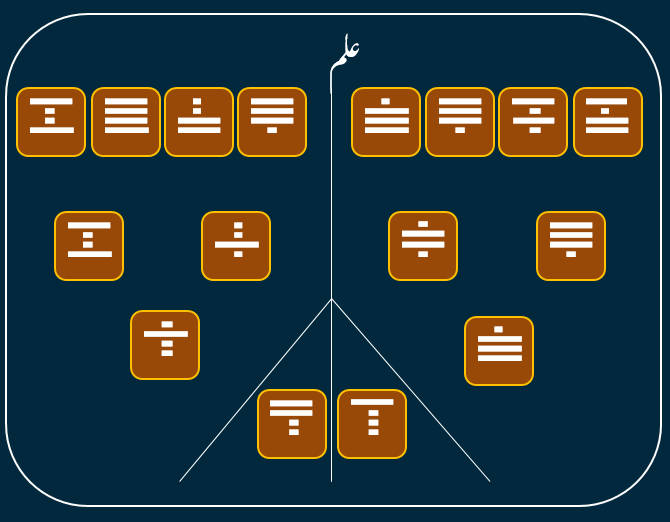
According to the above rules, the solution is as follows: In the first house is  Humrah, in the seventh is
  Jamaat, and in the tenth is
  Aqlah. All three figures are unfavorable. Therefore, in this case, the defendant will prevail.