


 Total views : 418
This is the question I am asked most often, because all work begins from here. Until you understand what the present time is like and which path you are heading on, you cannot make any decision correctly. It is very important to know what your condition is in the current circumstances, and which things you should avoid and which you should reflect upon. In previous articles, I answered many questions in very simple words, in a way that was sufficient for everyone to understand.
From today, we are going to delve deeper. We will discuss finer points and examine answers by placing many complex principles before us. The topics may now become lengthy and difficult, but within them there will be much that, once you understand it, will make you eager to seek guidance from ʿIlm al-Raml (the science of geomancy). This is a body of knowledge that is deeply connected to human beings. It keeps an eye on every aspect of us. What we think is what we ask, and what we ask is then analyzed in detail before an answer is given. If we are wrong and merely trying to test the knowledge, this science will give us an incorrect answer; but if we are sincere and right, it will stand by us and guide us to the very end.
Let me remind you that the name of this knowledge is ʿIlm al-Raml, and it is distinct from all other sciences. We have twelve houses and sixteen figures, along with their associated significations, and by keeping these in view, the answer to every question is derived.
Here, by fortune (ṭāliʿ) we mean knowing one’s current condition and state—and this is how it should be. No knowledge can tell you the conditions of your entire lifetime, because our circumstances change every moment through our actions and intentions. Therefore, the present situation is always examined first, and only then is a judgment made about right and wrong.
First, a chart is constructed and the first house is examined to see which figure is present there. One must consider whether this figure is strong or weak, entered or exited, inverted or fixed, and then determine whether it is auspicious or inauspicious. Simply by observing these matters, a judgment is passed according to the situation. Along with this, the figure of the ascendant and the figure of the witness house are also examined to see whether they are strong or weak in that position.
Then the following principles are considered:
-
If both figures are auspicious and strong, this indicates good health and strength of the ascendant.
-
If both figures are auspicious but external, then there is anxiety regarding rank, status, luxury, and the initiation of affairs. If both figures are auspicious, internal, and strong, then only the significations associated with those houses apply.
-
If both figures are auspicious and inverted, the querent will be constantly preoccupied with pleasure and luxury, day and night. If these figures are repeated in houses 5 and 11, the querent will keep the company of many desired companions. If the repetition is in houses 7 and 8, the querent will incline more toward servants or concubines. If the deficient figure is in houses 1 and 8, the querent will be passive (in a sexual sense), though it is better to remain silent about this matter. If the figure ʿAqlah appears in the first house, the querent will suffer a shock after a few days, or is already under distress at present.
-
If in both mentioned houses the figures are external and inauspicious, the querent will be extremely restless, worried, and uneasy.
-
If in both mentioned houses the figures are internal, the querent will be lazy and sluggish in his affairs and will be troubled due to corrupt thoughts.
-
If the figure is fixed, it indicates confusion and bewilderment in the querent’s affairs.
-
If the first house has an auspicious figure and the thirteenth house an inauspicious one, the ascendant is not considered auspicious—provided the figure in the first house is weak. If it is strong, the judgment will be passed according to its condition. Even if the ascendant is strong, the querent will not be free from sorrow and pain.
There are many more principles, but for the sake of simplicity I have mentioned only a few to help readers understand. Every geomancer examines the ascendant in his own way; my personal method is entirely different from this.
Now let us examine the fortune of a querent.
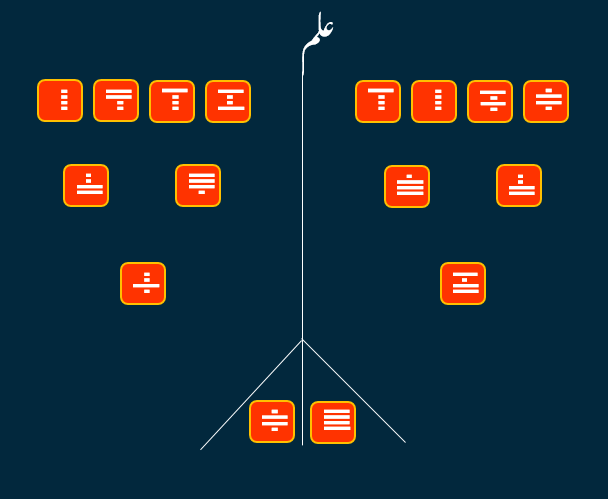
According to the aforementioned rules, consider this obtained chart. Information about the querent is being revealed. In the first house of the querent’s ascendant is the figure ʿAqlah  , which is an inauspicious, inverted, earthy figure associated with the planet Saturn. An earthy figure is strong in a fire house. Its witness house, the thirteenth, contains Ḥamrah
  , an inauspicious, fixed figure associated with the planet Mars, which also possesses strength in a fire house as an airy figure. Both figures are inauspicious. From this it is understood that the querent is extremely restless, troubled, and uneasy regarding his affairs.
According to the significations of the first house, a fixed and inverted figure is considered external—this is what the scholars of geomancy state.
Now, since ʿAqlah is in the first house, it indicates that the querent will receive a shock after a few days, or is currently under distress. The remaining matters are examined from the chart in the same manner.
It should be remembered that every chart in ʿIlm al-Raml is associated with the ascendant, but there is a vast difference between temporary questions and a complete chart. Therefore, it is better to have a full chart prepared to understand one’s overall conditions, while for a very urgent question or issue, guidance may be sought through a Horary chart.