

 Total views : 418
It should be clarified that Ilm-ul-Ramal is an exceptionally noble and authentic science, narrated by the elders of the faith (Buzurgan-e-Deen). Some companions refer to it as a “celestial science” (Ilm-e-Samawi) and consider it among the sciences of the Prophets. Some have attributed it to Hazrat Adam (A.S.), some to Hazrat Danyal (A.S.), some to Hazrat Nuh (A.S.), and others to Hazrat Idris (A.S.). However, the reasoning behind the descent of this knowledge remains consistent across these views. According to most books on spiritual sciences (Uloom-e-Ruhani), the authority for this sacred knowledge states that it was initially revealed by the Khaliq-e-Kainaat (Creator of the Universe) to Hazrat Adam (A.S.) through revelation (Wahi). After him, it was inherited by Hazrat Idris (A.S.). Janab Syed Ameer-ul-Mu’minin Hazrat Ali (Karam Allah Wajhu-ul-Kareem) also made pronouncements regarding it. Subsequently, Hazrat Danyal (A.S.) practiced it, and it was through him that this science became widely renowned.
 The author of these lines has, in his study of various books on Raml thus far, found this science most frequently attributed to Hazrat Danyal (A.S.). It is said that by the command of the Rabb-ul-Aalameen, Jibraeel Ameen (A.S.) arrived and placed his four fingers on the sand, which resulted in four points (Nuqta). The shape that emerged from these four points is called Abu-ul-Raml. These four points were associated with the four elements and divided into directions: the first point became Fiery (Aatishi) East, the second Windy (Badi) West, the third Watery (Aabi) North, and the fourth Earthy (Khaki) South. By multiplying this shape by itself, sixteen forms emerged, and through this divination, the states of all descendants were determined—who is in which direction and in what condition.
However, these accounts have been written by experts and masters in prestigious books. The author is unable to verify these historical claims personally, as for this humble servant, reviewing history is not as important as utilizing the principles and rules of the science to achieve one’s objectives.
Modern Context and Methodology
Ilm-ul-Ramal is called Geomancy in English. With changing times, innovation has entered this field as well. Scholars of every era introduced their own laws and, after countless experiments and observations, established rules and taught them to their students. However, a warning was also given: this knowledge should not be passed to just anyone, but only to those who are deserving. This practice is also prevalent in other sciences such as Ilm-ul-Jafar, Ilm-ul-Aadaad (Numerology), and Ilm-ul-Nuqoosh.
A practitioner of Ilm-ul-Raml is called a “Rammal” (Geomancer). The divination chart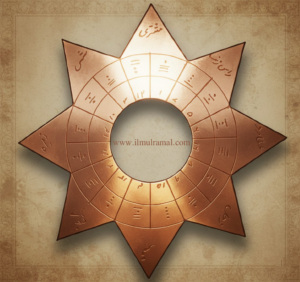 derived from Ilm-ul-Raml is called a “Chart” in most books, a term with which we disagree. In a Chart (horoscope), the determination of dates, month, year, and time is considered essential in addition to the question; however, in the principles of Raml, the forms are arranged by casting “Qur’ra” (Geomancy Dice), and then judgments are made. Nevertheless, when any seeker of knowledge practices for a long period, new paths open up to them. People of knowledge and spirituality are aware that knowledge itself possesses a form of life; if it becomes intimate with its seeker, it reveals its secrets and mysteries. The same applies to Ilm-ul-Huroof, Ilm-ul-Aadaad, and Ilm-ul-Jafar. Outwardly, these are speculative sciences. But when a bond of affection is established with these sciences through sincerity of heart and adherence to rules, the spiritual and internal mysteries begin to manifest in the practitioner’s subconscious mind, and the answer to every question begins to be received through an intuitive state (Wajdani Kaifiyat).