Before undertaking any task, it is better to think about its outcome so that problems can be avoided in advance. Such questions arise in the mind before starting any matter. In issues such as a new business, a job, marriage, travel, relationships, partnerships, education, buying and selling, and residence, these kinds of questions most often emerge. There are multiple rules for knowing the answer to this question, and every aspect is surely right on target, but I always advise the questioner to perform استخارہ.
The literal meaning of استخارہ is to seek goodness (welfare) from اللہ. In Islamic terminology, when one is uncertain about a permissible task or decision (such as marriage, travel, or business), offering two units of voluntary prayer and, through a specific prescribed supplication, asking اللہ تعالیٰ for guidance and betterment is called استخارہ.
However, some individuals only wish to derive an answer through علم الرمل. For this purpose, the current form of the house about which the question is asked is multiplied by the form of the fourth house to obtain a result. If this form is present in the chart and is a سعد form and, in houses 8 and 12, سعد forms are present in any capacity, then the questioner immediately gains benefit. If it is a fixed form, the benefit will be delayed. On the contrary, if this form is not present, or is مخفی یو or بنات or زیرِ بنات, and is نحس, or خارج, or منقلب, then the outcome is defective.
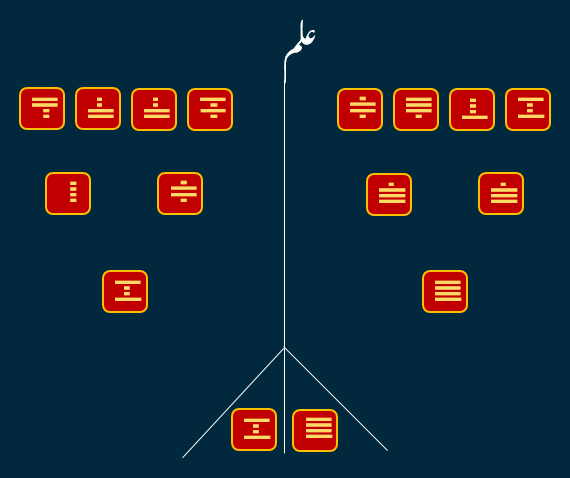
Under the above rules, suppose the question was related to employment, and the tenth house pertains to livelihood. In this house, لیحان سعد خارج آتشی is attributed to the planet مشتری. When this was multiplied by the form of the fourth house, عقلہ, the result obtained was انکیس. This form is present in the third house. Now observe that although the form of the first house, لیحان, was سعد, انکیس is نحس; therefore, it is concluded that the outcome will not be good.