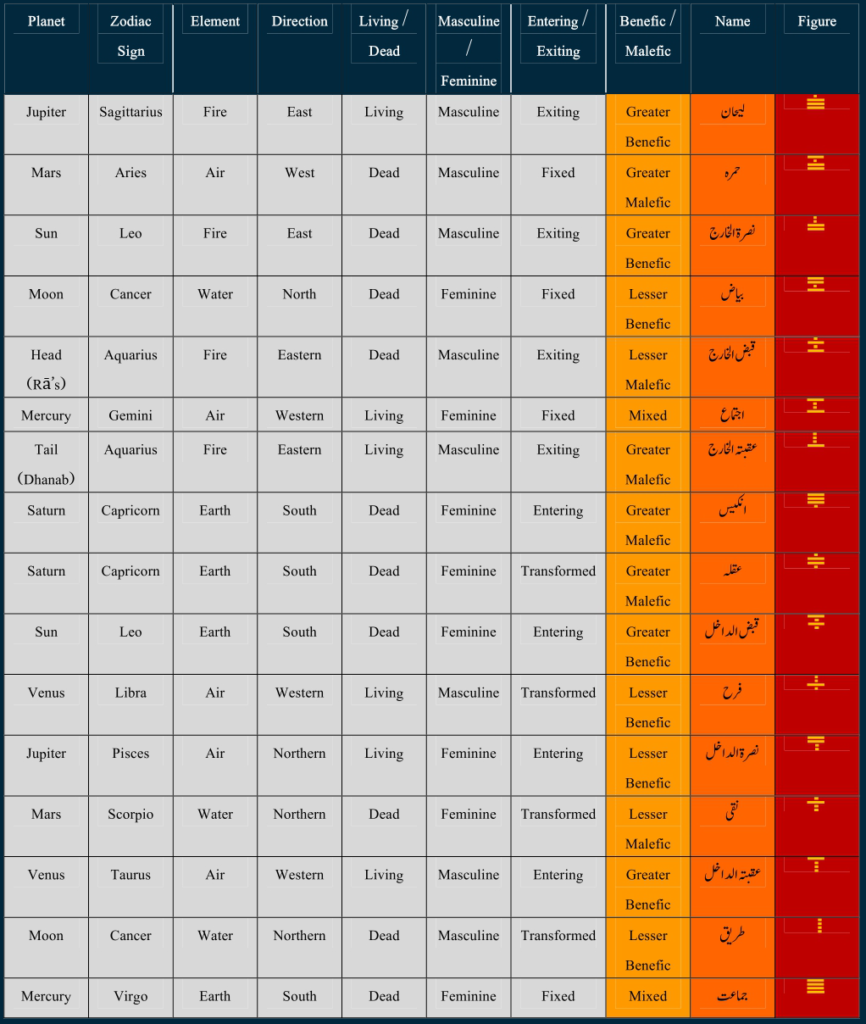
Above, we have written the Eternal Circle (Dā’irah-e-Abdah) along with its related matters, which are very important to understand. Among these sixteen figures, four are external, four internal, four transformative, and four fixed. Their explanation is now being written, because they must be kept in mind when applying judgments. In simple terms, these four categories of figures are connected with departure, entry, transformation, and stability.
Departure (Khurūj):
This refers to traveling, recovering from illness, being released from imprisonment or legal custody, the birth of a child emerging from the womb, and similar matters. If the question concerns departure and the external figure appears in the house of the question, the inquirer attains success in their objectives.
Entry (Dukhūl):
Entry refers to the acquisition of wealth, reunion with friends, marriage, receiving a letter or message, gaining possession of something, the return of someone who was absent, weddings and marriages, and similar matters.
Transformation (Munqalib):
This refers to changing residence, changing clothes, performing a ritual bath, going to another place, and similar changes. In matters of transformation, there is uncertainty as to whether something will occur or not.
Stability (Thubūt):
This refers to building a house, planting a garden, making covenants or agreements, and matters related to permanence and settlement. In matters of stability, the ruling indicates delay or pause.
Any question posed by an inquirer will fall within one of these four categories. First of all, the nature of the question should be examined.